
Your vehicle is stopped on or beside the road. Which statement about warning approaching traffic is correct?
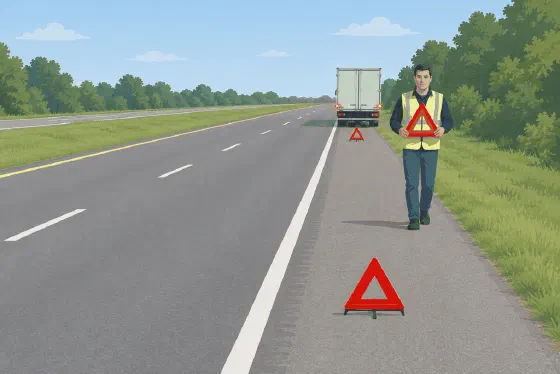
Correct answer: When a hill or curve hides your vehicle from sight within 500 feet, the rearmost triangle should be set farther back.
Answer options
- AAs long as your taillights are on, drivers coming up from behind have all the warning they need.
- BYou can leave the warning triangles in the cab unless you expect to stay stopped for 30 minutes or more.
- CWhen a hill or curve hides your vehicle from sight within 500 feet, the rearmost triangle should be set farther back. Correct
Why
Drivers need time to react, so if a hill or curve means they cannot see your stopped vehicle from 500 feet away, the rearmost triangle has to go farther back along the road. Triangles must be set out within 10 minutes of stopping, however long you plan to stay, and taillights alone are not a dependable warning.
Tip When a hill or curve limits the view, the rear triangle may need to go anywhere from 100 to 500 feet behind your vehicle.
About this question
Topic: Emergencies License: CDL
Part of these practice sets:
Where it applies: Asked in every state.
Practice the whole set
This question is part of CDL Practice Exam (50 questions). Take the full set and check your score.
Practice CDL Practice ExamMore questions from CDL Practice Exam
- When you stop for a railroad crossing, how far from the nearest rail should your vehicle come to rest?
- The vehicle in front of you displays an orange triangle bordered in red. What does this emblem indicate?
- For night driving, which lights should you use whenever it is safe and legal to do so?
- How quickly should the oil pressure come up to normal once you have started the engine?
- On wet pavement, roughly how much should you cut your normal driving speed?
- Your double-trailer rig is 100 feet long, and you are traveling 50 mph on a dry road with clear visibility. How many seconds of following distance should you leave at a minimum?
- Right after a tire fails, which of these actions should you avoid?
- How does an empty truck's stopping distance compare with that of a fully loaded one?
Practice on your phone.
Practice here in your browser, or use the app with the same questions and explanations. It's free on the App Store.