
When you parallel park along the curb on a flat street, what should you do?
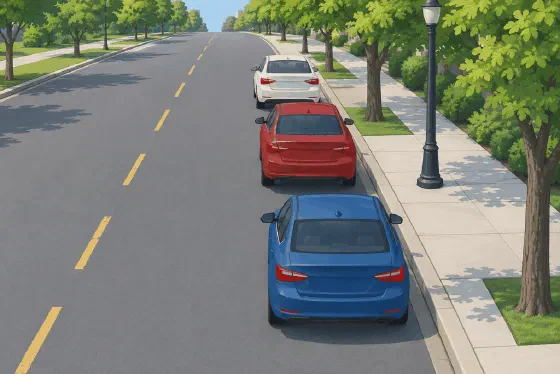
Correct answer: Keep your wheels no more than 12 inches from the curb.
Answer options
- ALet one rear wheel rest against the curb
- BKeep your wheels no more than 12 inches from the curb Correct
- CTurn your front wheels out toward the traffic lane
Why
Most states require a parallel-parked car to have its wheels within 12 inches of the curb, and some allow up to 18, so staying within 12 inches keeps you legal in either case. A wider gap leaves the car sticking out into the travel lane, where it becomes a hazard to passing traffic.
Tip A gap of roughly 6 to 12 inches keeps you within the limit while protecting your tires from the curb.
About this question
Topic: Parking License: Car permit
Part of these practice sets:
- Alaska: Road Rules
- Alabama: State Practice Set
- Arkansas: State Practice Set
- Arizona: Road Rules
- California: Road Rules
- Colorado: State Practice Set
- Connecticut: State Practice Set
- District of Columbia: State Practice Set
- Delaware: Road Rules
- Florida: Road Rules
- Georgia: State Practice Set
- Hawaii: Road Rules
- Iowa: Road Rules
- Idaho: Road Rules
- Illinois: Road Rules
- Indiana: State Practice Set
- Kansas: Road Rules
- Kentucky: State Practice Set
- Louisiana: Road Rules
- Massachusetts: State Practice Set
- Maryland: State Practice Set
- Maine: Road Rules
- Michigan: Road Rules
- Minnesota: Road Rules
- Missouri: State Practice Set
- Mississippi: Road Rules
- Montana: Road Rules
- North Carolina: State Practice Set
- North Dakota: Road Rules
- Nebraska: Road Rules
- New Hampshire: Road Rules
- New Mexico: Road Rules
- Nevada: Road Rules
- New York: Road Rules
- Ohio: State Practice Set
- Oklahoma: Road Rules
- Oregon: Road Rules
- Pennsylvania: Road Rules
- Puerto Rico: State Practice Set
- Rhode Island: Road Rules
- South Carolina: State Practice Set
- South Dakota: Road Rules
- Tennessee: State Practice Set
- Texas: Road Rules
- Utah: Road Rules
- Virginia: Road Rules
- U.S. Virgin Islands: Road Rules
- Vermont: Road Rules
- Washington: Road Rules
- Wisconsin: Road Rules
- West Virginia: Road Rules
- Wyoming: Road Rules
Where it applies: Used in practice sets for:
- Alaska
- Alabama
- Arkansas
- Arizona
- California
- Colorado
- Connecticut
- District of Columbia
- Delaware
- Florida
- Georgia
- Hawaii
- Iowa
- Idaho
- Illinois
- Indiana
- Kansas
- Kentucky
- Louisiana
- Massachusetts
- Maryland
- Maine
- Michigan
- Minnesota
- Missouri
- Mississippi
- Montana
- North Carolina
- North Dakota
- Nebraska
- New Hampshire
- New Mexico
- Nevada
- New York
- Ohio
- Oklahoma
- Oregon
- Pennsylvania
- Puerto Rico
- Rhode Island
- South Carolina
- South Dakota
- Tennessee
- Texas
- Utah
- Virginia
- U.S. Virgin Islands
- Vermont
- Washington
- Wisconsin
- West Virginia
- Wyoming
Practice the whole set
This question is part of Road Rules (32 questions). Take the full set and check your score.
Practice Road RulesMore questions from Road Rules
- Driving across public or private property as a shortcut around a traffic signal or sign is allowed only:
- Heavy traffic on a freeway with a 65 mph limit is flowing at 35 mph. Which speed is most likely best for you?
- When are you allowed to leave the pavement and use the edge of the road to get around another vehicle?
- Headlights are required during the hours of darkness. In the morning, when does that requirement end?
- Before which three actions is a look at the traffic behind you especially important?
- At what point in the evening does the law require you to have your headlights on?
- With no sign showing a different limit, what is the top legal speed in a residential district?
- In which situation should you tap the brakes so your brake lights blink, or use your hazard flashers?
Practice on your phone.
Practice here in your browser, or use the app with the same questions and explanations. It's free on the App Store.