
The three vehicles shown reach this intersection, which has no signs or signals, at the same time. In what order should they go?
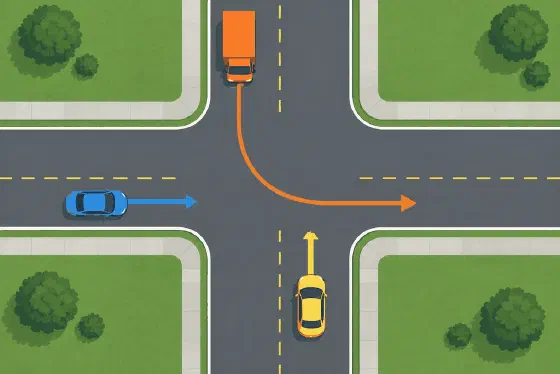
Correct answer: The yellow car, then the blue car, then the truck.
Answer options
- AThe blue car, then the yellow car, then the truck
- BThe yellow car, then the blue car, then the truck Correct
- CThe truck, then the blue car, then the yellow car
Why
When vehicles arrive together at an intersection without signs or signals, each driver yields to the vehicle on the right, and a driver turning left yields to oncoming traffic. The yellow car has nobody on its right and goes first; the blue car goes next, because the truck must yield both to the blue car on its right and, since it is turning left, to the oncoming yellow car.
About this question
Topic: Right-of-way License: Car permit
Part of these practice sets:
Where it applies: Used in practice sets for:
Practice the whole set
This question is part of Road Rules (28 questions). Take the full set and check your score.
Practice Road RulesMore questions from Road Rules
- One of your tires suddenly blows out while you are driving. What should you do?
- In which of these places or conditions should you reduce your speed?
- When you parallel park along the curb on a flat street, what should you do?
- Which of these does not affect your vehicle's stopping distance?
- You may not be able to avoid a crash. Which of these actions can lessen its severity?
- Your windshield wipers suddenly quit while it is raining or snowing. What should you do?
- At which of these times must your headlights be on?
- Which of these should you do while driving on a major highway?
Practice on your phone.
Practice here in your browser, or use the app with the same questions and explanations. It's free on the App Store.