Free Permit Practice Exam — 35 Questions with Answers
Alcohol and drugsKeyboard: A · B · C · Enter
About how long does it take a typical person's body to break down the alcohol from a single drink?
Why it's A: About one hour
On average, the body clears about one standard drink per hour, and nothing can hurry that along. Coffee, cold showers, and exercise do not make you sober any sooner; only time works.
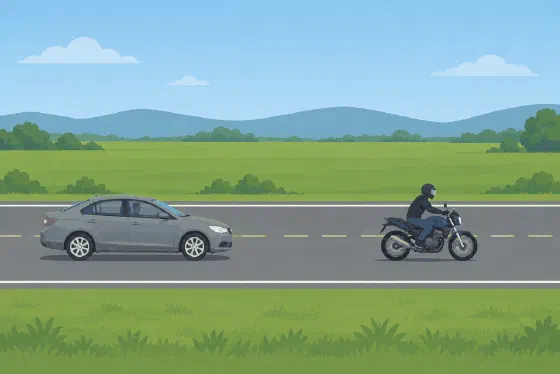
When you are following a motorcyclist, what are you required to do?
Why it's B: Let the motorcycle use the full width of its lane
A motorcycle has the same right to a full lane as a car, and riders often shift within the lane to avoid potholes, debris, or gusts of wind. Never try to share the lane with a motorcycle, pass it within its own lane, or drive on the shoulder next to it.
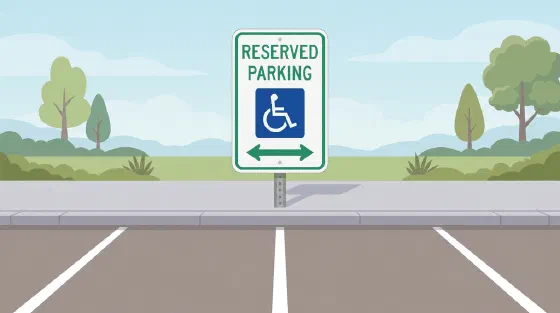
A driver who does not have a disability pulls up to a space like the one shown. Which statement about using it is true?
Why it's C: Parking, stopping, and standing there are all prohibited
Spaces marked for people with disabilities may be used only by vehicles displaying valid disability plates or a disability parking placard. Any other vehicle may not park, stop, or stand in the space, not even for a moment.
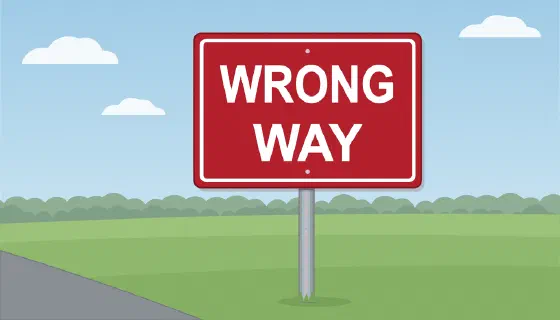
Why it's B: Do not go beyond this point; turn your vehicle around
The WRONG WAY sign is posted where a driver could enter a one-way street, a freeway ramp, or the far side of a divided highway against traffic. If it is facing you, you are heading into oncoming vehicles, so stop going forward and turn around when it is safe.
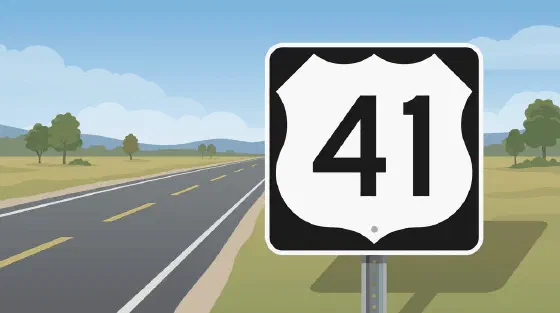
What kind of highway is identified by this marker?
Why it's B: A U.S. highway
Black numbers on a white shield set against a black square identify a U.S. route, part of the national numbered highway network, such as U.S. 20 here. Interstate shields, by contrast, are red, white and blue.
When heading down a hill, what is the best way to keep your speed under control?
Why it's A: Shift into a lower gear and brake gently as needed
A lower gear lets the engine help hold the vehicle back, so you only need light, careful braking instead of riding the brakes. This keeps the brakes from overheating and losing their stopping power on the way down.
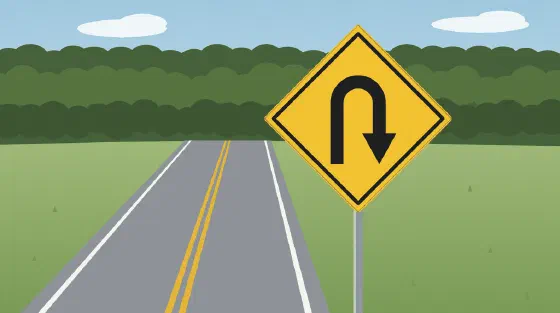
Why it's B: A hairpin curve that doubles back sharply to the right.
The arrow rises, swings over to the right, and heads back down, which marks a hairpin: a curve where the road reverses direction almost completely. Cut your speed sharply before you enter it.
Apart from oncoming traffic, in which situation must you switch to low beams when another vehicle is close by?
Why it's C: When you are coming up behind it
High beams shine into the mirrors of a vehicle ahead and can dazzle its driver, so switch to low beams when you are close behind a car you are following. A vehicle behind you, or one you have already passed, is outside the path of your headlights.
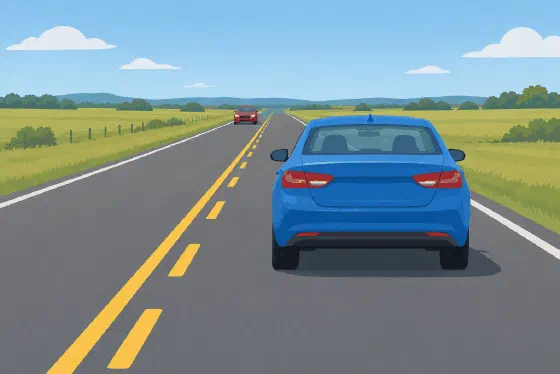
In normal driving conditions, how far back should you stay from the vehicle you are following?
Why it's B: A gap of three seconds.
In normal conditions, stay at least three seconds behind the vehicle ahead: when it passes a fixed object, you should be able to count three seconds before you reach the same spot. Leave even more room when the weather is bad or it is hard to see.
You hear the siren of a fire engine that is heading your way. What must you do?
Why it's A: Move to the roadside and come to a stop
A siren tells you that emergency responders need a clear path. Pull to the edge of the road, stop, and wait there until the fire engine has passed; slowing down or switching on your flashers is not enough, because you would still be in its way.
When you leave your car parked on a slope, how should the front wheels be set?
Why it's C: Turned so that a rolling car would hit the curb
Set the front wheels so that the curb would stop the car if it started to roll: angle them toward the curb if the car points downhill and away from it if the car points uphill. Apply the parking brake every time.
Tip Downhill means wheels toward the curb; uphill with a curb means wheels away from it.
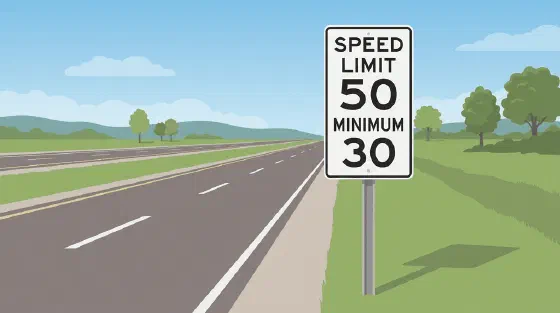
What is the purpose of posting a minimum speed limit?
Why it's B: To keep traffic moving at a smooth, steady pace
Minimum limits exist so traffic keeps moving evenly; a vehicle creeping far below the pace of everyone else disrupts the flow and invites rear-end collisions and risky passing.
You have just been in a traffic collision. What are you required to do?
Why it's A: Stop, aid anyone who is hurt, notify the police, swap information, and contact your insurer.
After any crash, a driver has to stop at the scene, give reasonable help to anyone hurt, notify the police, trade names, license, and insurance details with the others involved, and let their own insurance company know. Leaving the scene is against the law, and moving an injured person who is not in immediate danger can make their injuries worse.
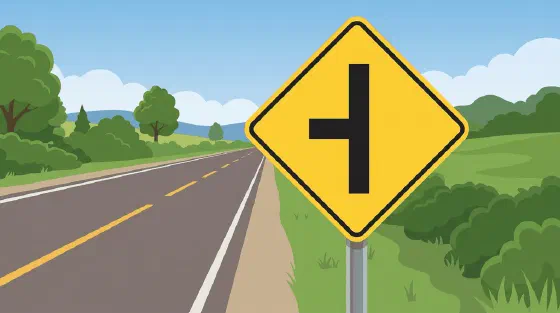
What is this yellow diamond-shaped sign warning you about?
Why it's C: A side road joins your road just ahead
This symbol warns that another road enters from the side a short way ahead, on the side the short bar points to. No stop or turn is required, but be ready for cars entering your road and for drivers ahead who slow down to turn off it.
Which of these statements about a learner's permit is accurate?
Why it's A: It never allows you to drive by yourself
Until you are licensed, every drive must include a licensed supervising driver riding with you. No hour of the day and no destination, not even your road test appointment, makes it legal to drive alone on a permit.
Which of these does NOT affect a person's blood alcohol concentration (BAC)?
Why it's C: Your level of physical fitness
BAC depends on how much alcohol you drink, how quickly you drink it, and how much you weigh. Being in good physical shape does not help your body clear alcohol any faster.
Which signal made with your hand and arm lets other motorists know that you intend to turn right?
Why it's A: Left arm out the window, elbow bent 90 degrees, hand pointing up
To show a right turn by hand, put your left arm out the window and raise your forearm so your fingers point up. Holding the arm straight out means a left turn, while pointing it down means you are slowing or stopping.
As you near an intersection, you notice that its traffic signal is flashing yellow. What are you expected to do?
Why it's B: Reduce speed and go through the intersection with care
A flashing yellow light is a warning, not an order to stop: ease off your speed, watch for pedestrians, cyclists, and vehicles already in the intersection, and yield to them before you continue. Stopping whenever it is safe is the rule for a steady yellow, and stopping before letting cross traffic go is the rule for a flashing red.
Up ahead, a person is walking across your lane where there is no crosswalk. How should you respond?
Why it's C: Stop until the person reaches the other side
Drivers must take every precaution to avoid hitting a pedestrian, even one crossing where there is no marked crosswalk. Come to a stop and wait until the person has crossed, since eye contact or a slower speed does not make passing safe.
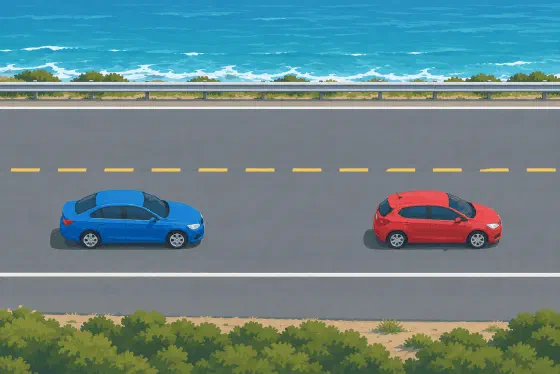
A double yellow line divides the two directions of traffic. When are you allowed to cross it in order to pass?
Why it's A: When the yellow line closest to your lane is broken
When two yellow lines run side by side, the one on your side tells you whether passing is allowed: a broken line next to your lane lets you pass when it is safe, while a solid line on your side means no passing. In the picture, the blue car has the broken line on its side and may pass, but the red car has the solid line and may not.
At night, an oncoming driver fails to switch from high beams to low beams. What should you do?
Why it's B: Look toward the right edge of the road, away from the glare
Switching on your own high beams in return only blinds the other driver and raises the risk of a crash. Instead, direct your eyes toward the right side of the road so the glare is not in your direct line of sight while you keep the oncoming vehicle in view.
What does the sign shown tell you about speed on this road?
Why it's A: Drive no faster than 50 mph and, when conditions are good, no slower than 30 mph
A sign with two numbers sets both limits: you may never exceed 50 mph, and in good conditions you should not drive slower than 30 mph. When rain, fog, snow or ice make 30 mph unsafe, you are expected to slow down even below the posted minimum.
Distraction and fatigueKeyboard: A · B · C · Enter
During a long trip, what helps prevent drowsiness?
Why it's C: Pulling over for a rest break at regular intervals
Fatigue builds over hours behind the wheel, and regular stops to rest, roughly every two hours or 100 miles, are the most reliable way to stay alert. Changing your speed does nothing to restore alertness.
Distraction and fatigueKeyboard: A · B · C · Enter
Drivers who snack or sip a beverage while driving are more likely to:
Why it's A: Struggle to keep their vehicle under control.
Food and drinks are a distraction: handling them takes a hand off the steering wheel and your attention off traffic. As a result, you steer less smoothly and react more slowly to hazards.
Why does a large truck need extra open space in front of it?
Why it's A: So its driver has room to stop
A heavy truck needs far more distance to stop than a car does. If you cut in closely ahead of one, you take away the room its driver needs to brake safely.
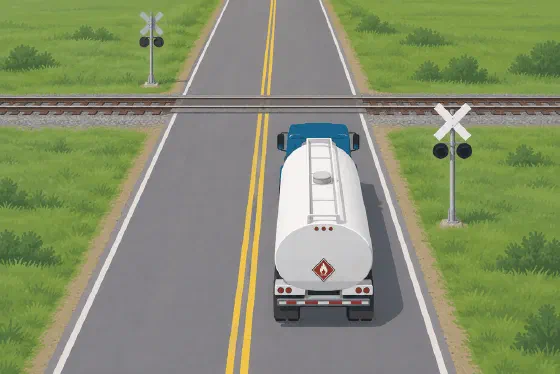
Even when no train is coming, which type of vehicle is required to halt at every set of railroad tracks?
Why it's B: A tank truck displaying hazardous materials placards
Tank trucks that carry hazardous materials placards must stop before every railroad crossing, whether or not a train is approaching. Motor homes, pickups with trailers, and vehicles that are simply large or heavy have no such blanket rule, although every driver must stop when a train is coming.
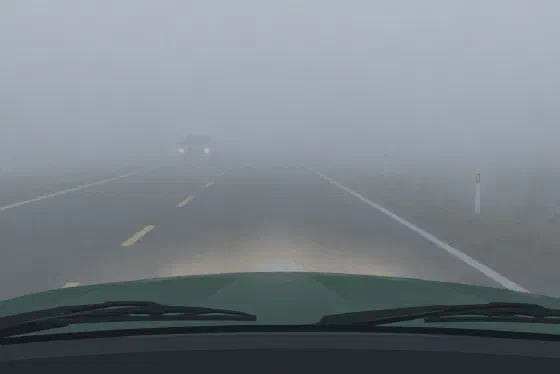
Which lights should be on when you are driving through fog?
Why it's C: Headlights on low beam
Low beams light up the road in fog without throwing light back into your eyes. High beams bounce off the tiny water drops in the air and create glare, while parking lights alone are too dim for other drivers to notice you in time.
If one of your tires suddenly blows out while you are driving, what is the right response?
Why it's A: Slow down gradually and then stop
A blowout can make the vehicle pull hard toward the damaged tire. Grip the wheel firmly, keep the car pointed straight, avoid hard braking, and let it lose speed gradually before pulling off the road to stop.
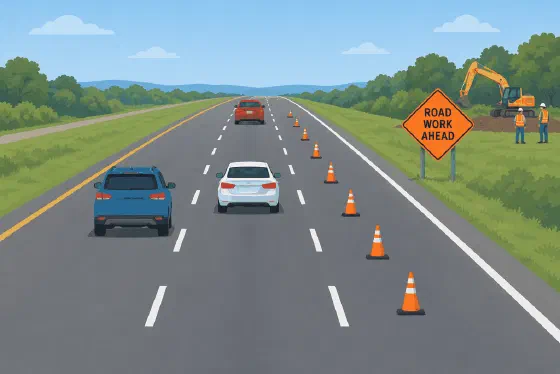
While on the freeway, you notice orange cones and road construction signs. What must you do?
Why it's A: Expect to find workers and machinery ahead
Orange signs and cones mark the start of a work zone, where crews and heavy machines may be on or beside the road. Reduce your speed, pay close attention, and watch for lane shifts and sudden stops.
On a freeway with a 65 mph limit, most traffic around you is moving at 70 mph or more. How fast may you legally go?
Why it's B: Up to 65 mph and no faster
The posted limit is the highest speed the law allows, no matter how fast other drivers choose to go. Keeping pace with speeding traffic is no excuse, and you can still be ticketed for going over 65 mph.
In your lane, a school bus has stopped in front of you and its red lights are flashing. What should you do?
Why it's C: Stop and stay stopped until the red lights stop flashing
Flashing red lights on a school bus mean children are getting on or off. You must stop and wait for the lights to go off; guessing that the children are clear or creeping past at low speed is never allowed.
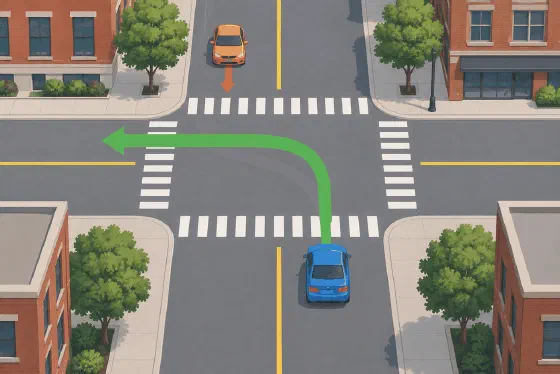
At an intersection with no STOP or YIELD signs, you are about to turn left. Which of these is correct?
Why it's A: You must yield to every approaching vehicle until you can turn safely
A left turn takes you across the path of oncoming vehicles, so at an intersection without signs or signals the duty to wait is yours. Turn only after approaching traffic has passed or is far enough away for you to finish the turn safely.
When should you turn on your signal if you plan to pass the vehicle ahead?
Why it's A: Well in advance, so nearby drivers can anticipate your move
Signaling well ahead of the lane change gives the drivers around you time to notice your plan and adjust their speed or position. A signal switched on at the last second, or after you have moved over, gives them no useful warning.
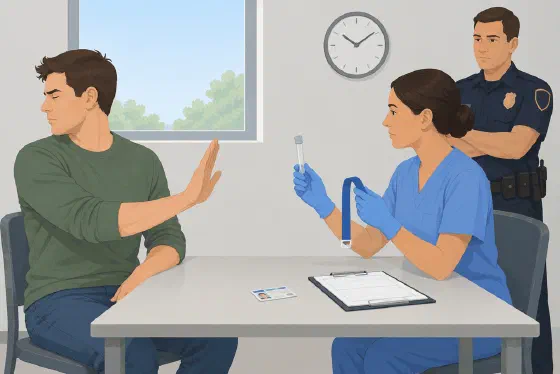
Following a DUI arrest, a driver declines to give a blood sample for testing. What consequence should the driver expect?
Why it's B: The driver's license will be suspended
Implied consent laws make a license suspension the penalty for refusing a chemical test after a DUI arrest. The DUI case can still go forward without a test result, so refusing does not make the charge disappear.
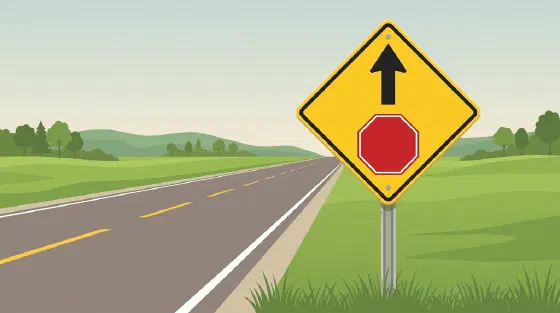
This yellow sign with an arrow and a red octagon gives advance notice of a stop sign that may be hard to see in time, for example beyond a curve or a hilltop. Begin slowing early so you can stop smoothly.