DMV Written Test home
CDL · Trailer Air Lines and CouplingQuestion 1 of 28 · untimed
Save & exit

CDL Trailer Air Lines and Coupling Practice Test

Combination vehiclesKeyboard: A · B · C · Enter

During ordinary driving, some truckers apply the trailer hand valve ahead of the foot brake, believing it prevents jackknifing. Which statement about this habit is correct?

Found a mistake? Report this question or use the form

All questions in this set with answers

Every question in this set has its own page with the correct answer and an explanation.

  1. During ordinary driving, some truckers apply the trailer hand valve ahead of the foot brake, believing it prevents jackknifing. Which statement about this habit is correct?
  2. You are testing the tractor protection valve. Which result shows that the valve is working properly?
  3. While your combination vehicle is moving, its service air line pulls apart, yet the emergency line holds. What is the immediate effect?
  4. How should you position the tractor as you prepare to back under a semitrailer?
  5. For a secure coupling, the fifth wheel jaws must grip which section of the kingpin?
  6. When you look over a fifth-wheel coupling after hooking up, what should you see?
  7. The fifth wheel jaws have closed on the kingpin, but the locking lever is not in the locked position. What does this tell you?
  8. How do you test whether the tractor and semitrailer are securely coupled?
  9. When you park a tank trailer, what should hold it in place?
  10. You have just charged the trailer's air system. How do you verify that the lines were not crossed and that the trailer brakes respond?
  11. When the trailer air supply knob is pushed in, what does it do?
  12. Which statement about air-braked semi-trailers built before 1975 is true?
  13. You are coupling to an older trailer and accidentally cross the air lines. What is the result?
  14. On a tractor-trailer, what are glad hands used for?
  15. Before the tractor backs under a semitrailer during coupling, how high should the front of the trailer be?
  16. Before coupling, how high should the trailer sit compared with the converter dolly's fifth wheel?
  17. When you drive a tractor with no trailer attached, why should its glad hands be locked together or onto dummy couplers?
  18. During coupling, your tractor is in front of the semitrailer but not yet under it. What do you connect before backing under?
  19. What must you confirm right before backing the tractor under a trailer?
  20. Which sequence is correct for testing the trailer service brakes?
  21. As air pressure drops, a tractor protection valve shuts by itself at a level set by its manufacturer. That level usually falls within which range?
  22. In which situation may a parked combination vehicle be held by the trailer hand valve alone?
  23. After coupling to a semitrailer, how should you leave the landing gear (front trailer supports) before pulling away?
  24. Before your tractor goes under the trailer, what condition must the entire air system be in?
  25. How do you get air flowing into the trailer's air tanks?
  26. What kind of equipment are glad hands?
  27. A fifth wheel plate that is not kept properly greased can lead to which problem?
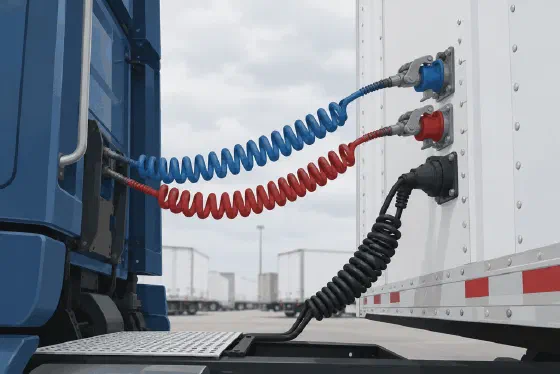
  28. Many combination vehicles use color-coded air lines so the two are not confused. Which colors are typically used?

More CDL practice tests