DMV Written Test home
CDL · Seeing, Signaling and Spotting HazardsQuestion 1 of 21 · untimed
Save & exit

CDL Seeing, Signaling and Spotting Hazards Practice Test

Signals and markingsKeyboard: A · B · C · Enter

As you drive toward an intersection, you notice the signal has stayed green for quite a while. How should you respond?
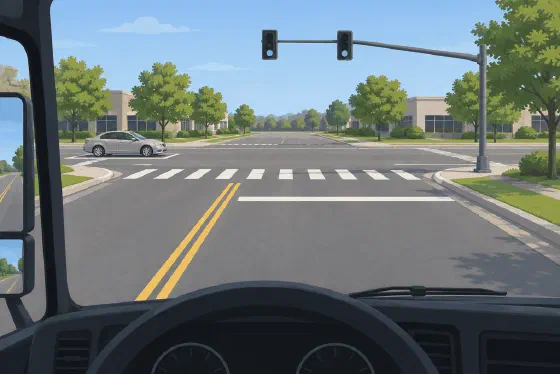
As you drive toward an intersection, you notice the signal has stayed green for quite a while. How should you respond?
Found a mistake? Report this question or use the form

All questions in this set with answers

Every question in this set has its own page with the correct answer and an explanation.

  1. As you drive toward an intersection, you notice the signal has stayed green for quite a while. How should you respond?
  2. At which points during a lane change should you look in your mirrors?
  3. In driving terms, what counts as a hazard?
  4. Regular mirror checks help you track the vehicles around you. Which of these should you keep in mind?
  5. If you have to travel at a very low speed, what should you do?
  6. The vehicle in front of you displays an orange triangle bordered in red. What does this emblem indicate?
  7. What is the right way to use your mirrors as you drive?
  8. What is correct about how you use your turn signals?
  9. When your heavy vehicle has to move slower than the rest of traffic, which practice should you avoid?
  10. Since a motorcycle's small size can fool you about its speed and distance, which of these should you do?
  11. At what points during a lane change should you look in your mirrors?
  12. What is important to keep in mind when you use your mirrors?
  13. What is the right way to look ahead while you drive?
  14. What is the main reason to keep watching for hazards on the road?
  15. Of all the reasons to watch for hazards while driving, which one matters most?
  16. A small cardboard box is lying in your lane up ahead. What is the best way to deal with it?
  17. When driving a truck, how far ahead should you scan, measured in seconds of travel?
  18. While driving a bus, how frequently are you expected to glance at the mirrors?
  19. When driving a bus, about how far ahead should you be looking, measured in seconds of travel?
  20. Convex mirrors, sometimes called "spot" mirrors, are found on some big trucks. What should you know about them?
  21. What is the main benefit of keeping watch for possible hazards as you drive?

More CDL practice tests