DMV Written Test home
CDL · CDL Practice ExamQuestion 1 of 50 · untimed
Save & exit

Free CDL Practice Exam — 50 Questions with Answers

Following distanceKeyboard: A · B · C · Enter

You are driving at 50 mph in a vehicle that is 40 feet long, on dry pavement with good visibility. What is the smallest following distance you should allow?

Found a mistake? Report this question or use the form

All questions in this set with answers

Every question in this set has its own page with the correct answer and an explanation.

  1. You are driving at 50 mph in a vehicle that is 40 feet long, on dry pavement with good visibility. What is the smallest following distance you should allow?
  2. A driver behind you is following much too closely. What should you do?
  3. Which part of the vehicle drives the air compressor?
  4. What is the main reason for backing a large vehicle toward the driver's side whenever you can?
  5. As someone keeps drinking and their blood alcohol concentration (BAC) climbs, which of these takes place?
  6. Which two actions do the most to keep a combination vehicle from rolling over?
  7. What should an en-route inspection, made during a trip, include?
  8. Which of the following counts as a problem with a wheel or rim?
  9. When you are traveling at 55 mph on dry pavement, how far will your vehicle go from the moment you spot a hazard until it stops?
  10. You have to swerve to avoid a collision. What is the right technique?
  11. How does an empty truck's stopping distance compare with that of a fully loaded one?
  12. Your double-trailer rig is 100 feet long, and you are traveling 50 mph on a dry road with clear visibility. How many seconds of following distance should you leave at a minimum?
  13. How quickly should the oil pressure come up to normal once you have started the engine?
  14. The vehicle in front of you displays an orange triangle bordered in red. What does this emblem indicate?
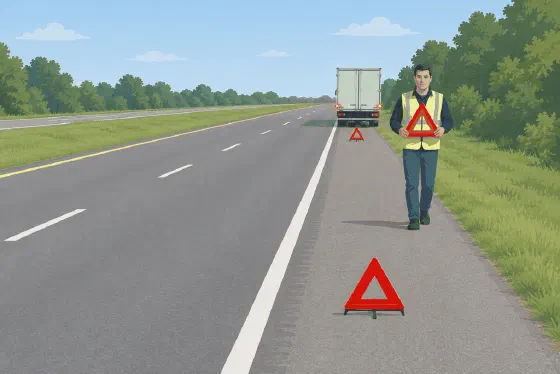
  15. Your vehicle is stopped on or beside the road. Which statement about warning approaching traffic is correct?
  16. When you stop for a railroad crossing, how far from the nearest rail should your vehicle come to rest?
  17. For night driving, which lights should you use whenever it is safe and legal to do so?
  18. On wet pavement, roughly how much should you cut your normal driving speed?
  19. Right after a tire fails, which of these actions should you avoid?
  20. If the antilock braking system (ABS) on your bus stops working, what should you do?
  21. When a vehicle catches fire, which of the following is correct?
  22. Which of the following is good advice about tire chains?
  23. Air brakes contain three separate braking systems. Two of them are the service brake and the parking brake. What is the third one?
  24. Which statement about escape ramps is true?
  25. When you must brake hard in an emergency, which principle matters most?
  26. What two things can tell you when it is time to change gears?
  27. Above all else, why should a driver inspect the vehicle?
  28. While you are driving, the warning light and buzzer for low air pressure suddenly come on. What should you do?
  29. Which area of a bus is off-limits to standing passengers?
  30. To prevent trouble over passenger comfort and safety rules, a bus driver should:
  31. Your CDL has no hazardous materials endorsement, and you are told to drive a placarded load of hazardous materials. How should you respond?
  32. Under ideal conditions, how much total distance does a vehicle with air brakes need to stop from 55 mph?
  33. What is the recommended way to work the brake pedal while descending a steep grade?
  34. Driving a tank vehicle calls for special care. Which pair of reasons explains why?
  35. Students are getting off at their assigned stop. Before you drive on, how far from the side of the bus must they be?
  36. Many people hold mistaken ideas about drinking alcohol. Which of these ideas is correct?
  37. You are taking your truck through a work zone. What should you do?
  38. Many combination vehicles use color-coded air lines so the two are not confused. Which colors are typically used?
  39. Which description of stab braking is accurate?
  40. Which statement about a load's center of gravity is true?
  41. When a vehicle is required to display hazardous materials placards, on how many of its sides must they appear?
  42. How can you tell whether a load you are about to haul contains any hazardous materials?
  43. What is true about an overheated engine and its cooling system?
  44. A traffic signal you are nearing has stayed green for quite some time. What is the safest way to approach it?
  45. The trailer you are pulling begins to skid. What is the correct action?
  46. When you use a fire extinguisher, which practice is correct?
  47. Under the general rule for securing cargo, you need a minimum of one tie-down for each:
  48. Your vehicle is hydroplaning, with the tires skimming over a layer of water. What is the correct response?
  49. Regarding the clearance above your vehicle, which statement is correct?
  50. At which moments should you look in your mirrors when moving into another lane?

More CDL practice tests