Which statement about refueling a bus while passengers are aboard is correct?
Fuel vapors and spills create a fire risk, so a bus should be refueled with riders on board only when there is no other option, and never inside a closed building.
A bus driver has to keep track of the riders as well as the traffic, so checking the interior and the area around the bus on a regular basis is a good habit. Watching only the vehicles beside you is too narrow, and drivers should look roughly 12 to 15 seconds ahead rather than 5 to 7.
Your duty to keep a disruptive rider safe does not end when you remove that person, so choose the next scheduled stop or a well-lighted place where other people are present. A dark, isolated spot or one off the route could leave the rider in danger.
When the rear door of an urban transit coach is open, the interlock sets the brakes and holds the throttle at idle; closing the door releases it. It is only a safety aid and must never be used instead of the parking brake.
A driver is responsible for the safety of the rider being removed as well as everyone else on board, so the drop-off spot matters. Waiting for the next regular stop or a lighted place where other people are present is often the safer choice.
On city transit buses, opening the rear door makes the interlock set the service brakes and hold the throttle at idle until the door closes again. It is only a safety aid and never takes the place of the parking brake.
Passengers who are standing can easily lose their balance, and a sharp start, turn or stop can throw them off their feet. Driving smoothly and waiting until riders are seated before moving prevents many of these injuries.
Tip Abrupt stops and doors that move too fast are behind a large share of bus injuries, so make sure riders are secure before you move.

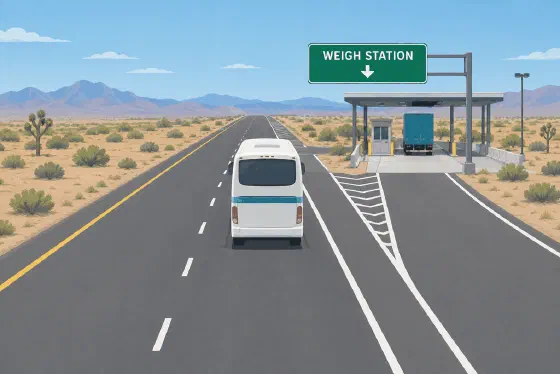
There is no single national requirement for buses to enter weigh stations. Each state sets its own policy, so a coach may have to pull in on one state's highways and be exempt in the next.
Put an unruly passenger off only where it is as safe as possible, such as the next scheduled stop or a well-lit place with other people around. Picking a dark or isolated spot for your own convenience could put that person in danger.
On a transit bus, the interlock sets the brakes and keeps the accelerator at idle whenever the rear door is open, then releases once the door shuts. Because it is only a safety aid, you must still set the parking brake and never rely on the interlock to hold the bus.
A bus driver must keep track of several things at once: the road ahead, the traffic beside and behind the bus, and the passengers riding inside it.
Fuel vapors can collect in an enclosed building and catch fire, so a bus carrying riders is never refueled indoors; it is best not to fuel with riders aboard at all unless it is truly necessary.
Driving takes your full attention, so set the seat, mirrors and radio before you get underway. If anything needs changing later, wait until the bus has stopped.
Passengers normally get off a broken-down bus before it is towed or pushed. The exception covers passengers who cannot get off or for whom getting off would be more dangerous, and then the bus should go only as far as the nearest safe place to unload them.
Passengers should normally get off a disabled bus before it is moved. The exception is when leaving the bus would expose them to more danger, and even then the bus should be moved just to the nearest safe spot where they can get off.
Tip Unloading the passengers comes first in nearly every breakdown; moving the bus with them inside is reserved for when unloading is the greater risk.
Leaving a stop calls for extra care: buses swinging back into traffic have hit passing cars or torn off their mirrors, and low-hanging branches or poles near the curb can damage the bus just as easily.
A few light taps on the brake pedal make your brake lights flash, which tells following drivers that you are about to stop. Stopping abruptly invites a rear-end crash, and you should never wave other drivers around you.
Conversation with passengers, or any other distraction, is banned while you drive. Fueling with passengers on board is allowed only when truly necessary and never inside an enclosed building, and a broken-down bus with passengers may be towed or pushed only as far as the closest safe spot to unload them.
Refueling with riders on the bus should be avoided whenever possible, and it must never be done inside a closed building while they are aboard, where fuel vapors and any fire would put them at serious risk. Turning the engine off is a normal part of safe fueling.
Most bus crashes take place at intersections rather than on the open road. Approach each intersection with care, even if the right-of-way is yours, because other drivers may not see you or may fail to yield.
Every question in this set has its own page with the correct answer and an explanation.