CDL Inspecting Your Vehicle Practice Test — 32 Questions
Vehicle inspectionKeyboard: A · B · C · Enter
How should you check that the service brake is working?
Why it's C: Roll forward at about 5 mph and press the brake pedal firmly
With normal air pressure built up and the parking brake released, roll ahead at roughly 5 mph and press the pedal firmly. The vehicle should stop without pulling to one side, feeling odd or responding late.
Which of the following should parts of the exhaust system never do?
Why it's C: All of these are correct
Exhaust parts run very hot, so they must be securely mounted, free of leaks and kept clear of the tires, the fuel system and other moving parts. Contact with those parts can damage them or start a fire, and a loose or leaking exhaust can also let poisonous fumes into the cab.
As you look over the tires during a pre-trip inspection, which statement is accurate?
Why it's A: A vehicle should not be fitted with tires of different sizes.
Tires of mismatched sizes are a defect to catch during the pre-trip inspection. Radial and bias-ply tires should not be used together, and front tires need at least 4/32 inch of tread in every major groove, so 2/32 inch is too little for them.
What problem can let toxic carbon monoxide gas get into the cab?
Why it's B: A leaking exhaust system
Carbon monoxide is part of engine exhaust, so broken, loose or leaking exhaust parts can let it seep into the cab, where it can cause drowsiness or even death. Low oil or coolant can damage the engine but does not send exhaust gas into the cab.
Should radial tires and bias-ply tires be used together on one vehicle?
Why it's C: No, they should not be mixed
The two tire types are built differently and flex in different ways, so combining them on one vehicle can make it handle unpredictably. Driving on packed snow does not make the combination acceptable.
When checking the engine compartment before a trip, which item are you NOT expected to inspect?
Why it's A: The valve clearance
Before a trip you look over the engine compartment for problems you can spot or feel, such as leaks, low fluid levels, loose belts, damaged hoses and worn wiring insulation. Checking valve clearance calls for precise measurements with special tools, so it belongs to scheduled maintenance by a mechanic.
A service brake test belongs in every pre-trip inspection, since a weak brake or one that pulls to the side is far safer to discover before you leave than in traffic. The check is the driver's job, not something to save for a mechanic or a yearly inspection.
Which of the following counts as a defect in the suspension system?
Why it's C: All of these are correct
A cracked or broken spring hanger and a leaking shock absorber both weaken the suspension, which holds up the vehicle and its load and keeps the axles in place. Suspension damage like this must be repaired before the vehicle goes back on the road.
Why it's C: To protect yourself and other road users
Safety comes first: an inspection helps you find defects that could cause a crash or breakdown and put you and everyone around you at risk. Inspections are also required by law and can prevent expensive repairs, but those are secondary reasons.
At a minimum, how deep must the tread be in every major groove of a commercial vehicle's front tires?
Why it's A: 4/32 inch
A front tire must have tread at least 4/32 inch deep in each major groove, and all other tires at least 2/32 inch. A tire worn below those depths is a defect that has to be corrected before the trip.
For a commercial driver, a pre-trip inspection is:
Why it's B: a legal requirement.
Commercial drivers are legally obligated to inspect their vehicle before every trip, however short, so that defects are found before they can endanger passengers or other road users.
When you check how well the service brakes stop your vehicle, roughly how fast should you be going?
Why it's C: 5 mph
To check the service brakes, roll forward slowly at about 5 mph and press the brake pedal firmly. If the vehicle pulls to one side, the pedal feels unusual or the stop is delayed, the brakes may have a problem.
The steering system of a heavy vehicle includes which of these parts?
Why it's D: All of these are correct
The steering system links the steering wheel to the front wheels through a chain of parts that includes the steering shaft, the gear box, the Pitman arm, the drag link, the steering arms and the tie rod. Each of them should be checked for looseness, wear and damage.
When you inspect the wheel bearing seals, what should you look for?
Why it's A: Any sign of leaking
These seals keep lubricant inside the wheel hub, so you confirm that none is seeping out. A leaking seal can let the bearing run short of lubricant, overheat and fail.
Which items are part of a proper walk-around inspection?
Why it's C: All of these are correct
A walk-around covers the whole vehicle, including the steering and suspension parts: the front axle should not be cracked or bent, and the shock absorbers should not be leaking or broken. Tires, wheels, brakes, lights and couplings are checked on the same walk-around.
Tip If each listed item is something a real inspection covers, expect the all-inclusive choice to be the answer.
When inspecting wheels and rims, which of these is a defect you should look for?
Why it's C: All of these are correct
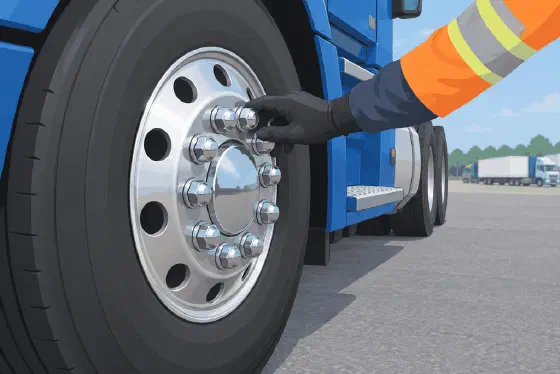
A wheel or rim fails inspection if a lock ring is mismatched, bent or missing, or if any clamp, spacer, stud or lug is gone. Also watch for damaged or weld-repaired rims and for rust streaks near the lug nuts, which can mean the nuts are loose.
What is the proper way to check a vehicle's hydraulic brakes for a leak?
Why it's B: Pump the pedal three times, then hold it down firmly for five seconds; any pedal movement could mean a leak
After pumping the pedal three times, hold firm, steady pressure on it for five seconds. A pedal that stays put means the system is in good shape, while one that slowly sinks points to a leak or some other fault.
When you do a pre-trip inspection, which statement about the vehicle inspection report is true?
Why it's C: You should go over the most recent report
Reviewing the last inspection report is an early step of every pre-trip inspection, because it shows which defects were reported and whether the carrier certified that they were repaired or did not need repair. It is part of every inspection, not something done only when a supervisor asks or passengers are aboard.
Why should you keep the ignition key in your pocket while you perform the pre-trip inspection?
Why it's A: So nobody can move the vehicle while you are under it
With the key on you, no one can start the engine and drive off while you are working beneath or beside the vehicle, where a sudden move could cause serious injury.
During the walk-around part of the inspection, which group of items should you check at the front of the vehicle?
Why it's B: Front axle, steering system, lights and reflectors, and windshield
At the front of the vehicle, the walk-around covers the front axle, the steering system (no loose, worn, bent or missing parts), the lights and reflectors (clean, working and the right color) and the windshield (undamaged, with wipers in good shape). Paint, trim and decals are cosmetic and play no part in this safety check.
Which of these should you do to keep checking your vehicle while a trip is under way?
Why it's C: All of these are correct
Inspection continues after you pull away. Glance at the gauges regularly, and pay attention to anything you see, hear, smell or feel that could signal a developing problem.
Which set lists the three kinds of emergency equipment a commercial vehicle is required to carry?
Why it's C: A fire extinguisher, spare electrical fuses and three reflective warning triangles
Required equipment on a commercial vehicle includes warning devices for a stopped vehicle (for example, three reflective triangles), a fire extinguisher, and spare electrical fuses, which are unnecessary when the vehicle has circuit breakers. A spare tire, a jack, and a radio are not on the list.
Your pre-trip inspection turns up something unsafe. What does the law require you to do?
Why it's A: Have it repaired before you drive the vehicle
Federal and state laws prohibit driving a vehicle that is not safe, so a defect found before a trip must be repaired before the vehicle is driven. Driving carefully or simply noting the problem on a report does not make an unsafe vehicle legal to operate.
As you walk up to your vehicle to begin a pre-trip inspection, what should you do?
Why it's B: Check beneath it for leaking fuel and for fresh oil, coolant, or grease
The vehicle overview starts as you walk up: note the general condition and look underneath for fresh fluid leaks that may point to a mechanical problem. Starting the engine and measuring tire pressure with a gauge are later steps of the inspection.
Why it's C: They should not touch each other at all
The two tires of a dual set need space between them; if they rub against each other or against the vehicle, the friction creates heat and wear that can lead to a blowout. Contact can also be a sign of mismatched sizes or low air pressure.
In what situation should you check that the parking brake works?
Why it's A: While the vehicle is parked
The check is done with the vehicle stopped: set the parking brake, then gently try to pull forward against it in a low gear to make sure it keeps the vehicle from moving. Trying it at speed or on a downhill stretch would be dangerous if the brake did not hold.
The driver who used the bus before you left an inspection report. When is it appropriate to sign it?
Why it's B: After confirming each listed defect was fixed or needed no repair
Part of confirming a bus is safe is reviewing the last driver's inspection report. Sign it only after you have verified that each defect on it was fixed, or that a repair was found to be unnecessary.
Which of the following is accurate about checking wheels and rims during a pre-trip inspection?
Why it's C: Rust around the lug nuts can be a sign that they have loosened
Rust around the lug nuts is a common clue that they have loosened. Welding does not make a cracked wheel or rim safe, and a wheel missing even one lug nut is defective, so either problem must be repaired before the vehicle is driven.
Once you start the engine, how quickly should the oil pressure reach its normal level?
Why it's A: Within a few seconds
A healthy engine builds normal oil pressure just seconds after it starts. If the gauge stays low, turn the engine off at once, because running without lubrication can ruin it quickly.
What is the minimum tread depth required in every major groove of a front tire?
Why it's B: 4/32 inch
Front tires, which do the steering, must keep a minimum of 4/32 inch of tread in each major groove; other tires may go as low as 2/32 inch. Deeper tread up front helps you keep steering control.
A commercial vehicle's emergency equipment should include how many red reflective warning triangles?
Why it's C: Three
Federal safety rules call for a set of three red reflective warning triangles. Whenever a breakdown leaves you stopped on or beside the road, put them out promptly so approaching drivers are warned in time.
At what point are you required to fill out a vehicle inspection report?
Why it's A: When your shift is over
Drivers who work for an interstate carrier must fill out a written inspection report when each shift ends, covering every vehicle they operated that day.