Arizona MVD Road Rules — 28 Questions with Answers
Night and weatherKeyboard: A · B · C · Enter
Which habit helps keep your vehicle from skidding when the road is slippery?
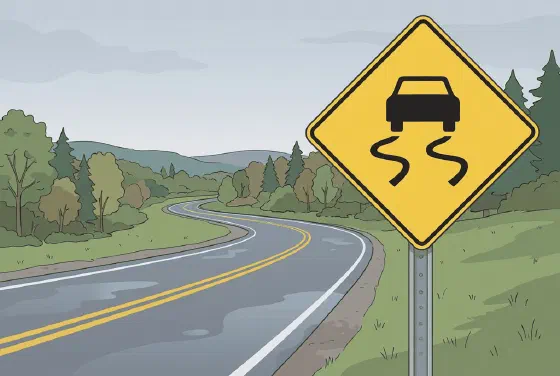
Why it's C: Reduce your speed ahead of curves and intersections
Slippery pavement gives your tires less traction, so lose speed before a curve or intersection rather than while you are in it. Speeding into a curve, or waiting until you are already descending a hill to downshift, makes a skid more likely.
The school bus ahead of you stops and turns on its flashing red lights. What does the law require you to do?
Why it's B: Come to a stop at least 25 feet behind the bus
A school bus stopped with its red lights flashing is letting children on or off, and they may walk across in front of traffic. You must halt at least 25 feet away and stay there until the red lights turn off and the stop arm retracts.
With no sign showing a different limit, what is the top legal speed in a residential district?
Why it's A: 25 mph
Without a sign showing otherwise, residential districts carry a 25 mph limit. Homes along the street mean children, walkers and bike riders may appear suddenly, so keep your speed down and stay ready to brake.
Which of these should you do while driving on a major highway?
Why it's D: All of these are correct
High speeds and heavy traffic on major highways leave little time to respond, so you need to stay focused, scan the road and mirrors continually, and be ready for hazards such as stalled vehicles, debris, or sudden slowdowns.
Your windshield wipers suddenly quit while it is raining or snowing. What should you do?
Why it's D: All of these are correct
When the wipers fail in rain or snow, ease off your speed at once, open the driver's window and look out of it if that is the only way to see, and then brake and leave the road at a safe spot. Wait there with your hazard flashers on until the weather clears or the wipers are fixed.
Which of these does not affect your vehicle's stopping distance?
Why it's B: What time of day it is
Stopping distance is the ground you cover while reacting plus the distance needed to brake, so it changes with your speed, reaction time, the road surface, your tires and your brakes. The hour on the clock does not change how your brakes and tires work, although darkness may call for a slower speed.
In which of these places or conditions should you reduce your speed?
Why it's D: All of these are correct
Tight or curving roads, intersections, railroad crossings, and wet or slippery pavement all leave less room for error. A lower speed buys you reaction time and cuts the distance you need to stop.
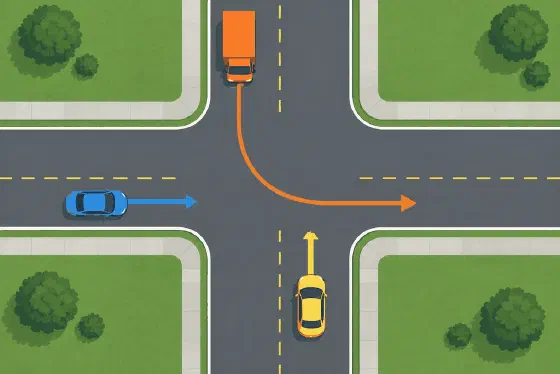
The three vehicles shown reach this intersection, which has no signs or signals, at the same time. In what order should they go?
Why it's B: The yellow car, then the blue car, then the truck
When vehicles arrive together at an intersection without signs or signals, each driver yields to the vehicle on the right, and a driver turning left yields to oncoming traffic. The yellow car has nobody on its right and goes first; the blue car goes next, because the truck must yield both to the blue car on its right and, since it is turning left, to the oncoming yellow car.
One of your tires suddenly blows out while you are driving. What should you do?
Why it's B: Slow down gradually and then stop
After a blowout, hold the steering wheel firmly, take your foot off the accelerator, and keep the car going straight while it loses speed on its own. Braking hard can make you lose control, so stop only after you have eased off the road to a safe spot.
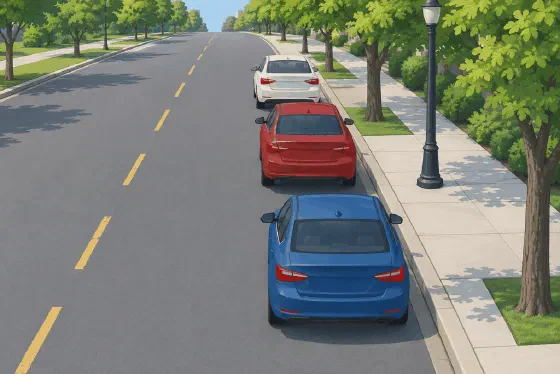
When you parallel park along the curb on a flat street, what should you do?
Why it's B: Keep your wheels no more than 12 inches from the curb
Most states require a parallel-parked car to have its wheels within 12 inches of the curb, and some allow up to 18, so staying within 12 inches keeps you legal in either case. A wider gap leaves the car sticking out into the travel lane, where it becomes a hazard to passing traffic.
Tip A gap of roughly 6 to 12 inches keeps you within the limit while protecting your tires from the curb.
You may not be able to avoid a crash. Which of these actions can lessen its severity?
Why it's C: All of these are correct
When a crash cannot be avoided, the goal is to reduce the force of the impact. A glancing blow spreads the energy out, and hitting something that is not moving involves less force than meeting a vehicle head-on, so both actions lower the risk of serious injury.
At which of these times must your headlights be on?
Why it's D: All of these are correct
Headlights are required from half an hour after sunset until half an hour before sunrise, plus whenever rain, fog, snow, or dim light makes people and vehicles hard to see. They help you see the road and help others see you.
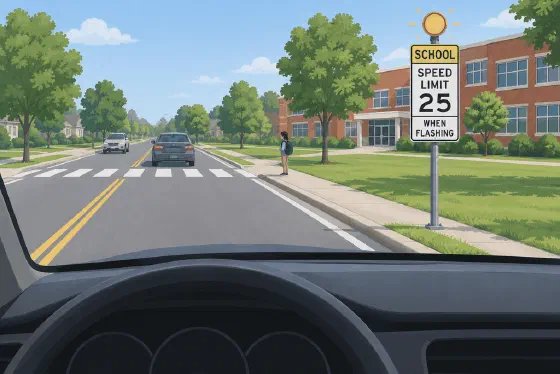
Which of these actions is forbidden while you drive through a school zone like this one?
Why it's B: Passing a car stopped at a crosswalk to let children cross
You must not pass or go around a vehicle that has stopped for people at a crosswalk, because it may be hiding a child who is stepping into the road. Obeying the school speed limit and letting children cross first are things you must do, not things you must avoid.
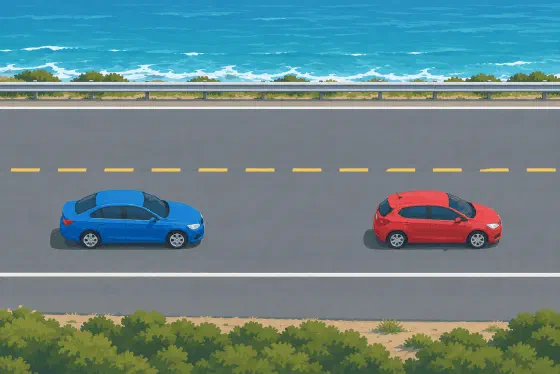
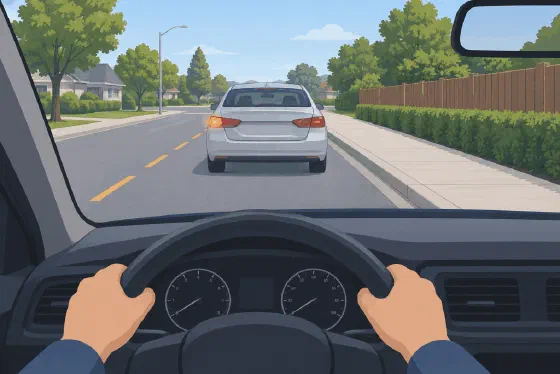
The blue car is traveling behind the red car. What spacing guideline should the blue car's driver follow?
Why it's C: A gap of 3 to 6 seconds
Arizona's manual teaches a cushion of 3 to 6 seconds: when the car ahead passes a fixed point, such as a sign or overpass, count the seconds until you reach the same spot. Leave even more room in poor weather or on bad roads.
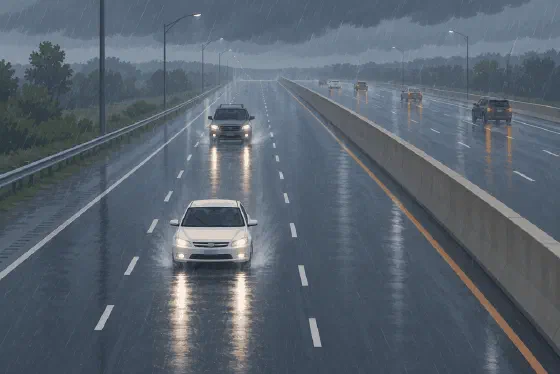
Heavy rain has left the pavement wet. What should you do?
Why it's A: Leave more space between you and the vehicle in front
Water on the pavement makes stopping take longer, so open up a gap of at least 4 to 5 seconds behind the vehicle ahead. Brake, steer and accelerate gently to avoid skidding.
Tip On wet pavement, plan on about twice your usual following distance so you have room to stop.
Driving across public or private property as a shortcut around a traffic signal or sign is allowed only:
Why it's C: When a police officer tells you to
Cutting through a parking lot, gas station or other property to dodge a traffic control device is against the law. The only exception is when a police officer instructs you to do it, because an officer's directions take priority over signs and signals.
An emergency vehicle with its siren sounding has just gone past you. What are you required to do now?
Why it's C: Do not follow it any closer than 500 feet
Emergency vehicles may stop or turn without warning, and others may be following, so the law requires you to stay back at least 500 feet once one has passed. Trailing it closely is dangerous, and after it goes by you may resume normal driving while keeping that distance.
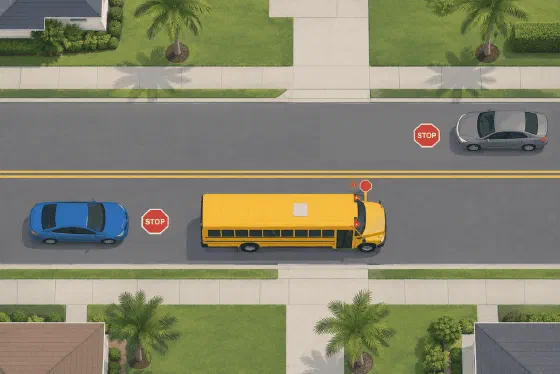
On a two-lane road, a school bus coming from the opposite direction stops and turns on its flashing red lights. What must you do?
Why it's B: Bring your vehicle to a stop
If a school bus stops on a two-lane road with its red lights flashing, traffic approaching from either direction has to stop and stay put until the lights go off and the bus moves on. Simply slowing down is not sufficient, including when the bus is on the opposite side of the road.
Tip Drivers on the far side of a highway split by a physical divider, such as a raised median, are not required to stop.
When you leave your car parked on a slope, how should the front wheels be set?
Why it's C: Turned so that a rolling car would hit the curb
Set the front wheels so that the curb would stop the car if it started to roll: angle them toward the curb if the car points downhill and away from it if the car points uphill. Apply the parking brake every time.
Tip Downhill means wheels toward the curb; uphill with a curb means wheels away from it.
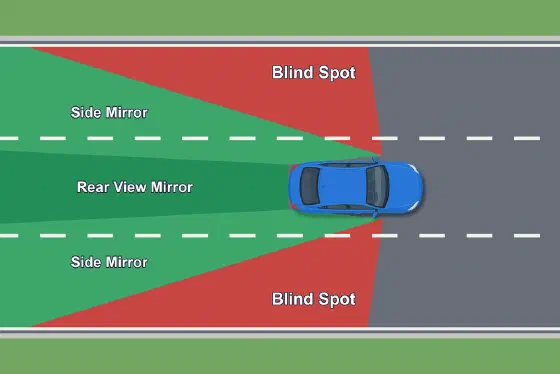
The picture shows what your mirrors can cover and the blind spots they miss. What should you do before changing lanes?
Why it's A: Use your signal, check your mirrors, and look over your shoulder
Signal first to warn other drivers, use your mirrors to check traffic beside and behind you, and then turn your head to look over your shoulder, because the mirrors cannot show the blind spots marked in red. Skipping the head check, or signaling only after you move, can lead to a crash with a vehicle you did not see.
Before which three actions is a look at the traffic behind you especially important?
Why it's B: Backing up, changing lanes and braking suddenly
Before you back up, change lanes or brake suddenly, check the traffic behind you with your mirrors and by turning your head. Look over your shoulder through the rear window when backing, and check your blind spot before moving into another lane. These are the moments when a collision with someone behind you is most likely: backing takes you toward whatever is back there, and if you change lanes or brake hard, a vehicle coming up behind you may have no room to avoid you.
When it comes to a safe speed for your vehicle, which statement is true?
Why it's B: It changes with the weather and the road conditions.
No one number is safe in every situation. Choose your speed based on the weather, the road surface, how far you can see and how heavy traffic is, and remember that driving under the limit can still be too fast in poor conditions.
When are you required to yield to an emergency vehicle?
Why it's B: Whenever you hear a siren or see red or blue lights flashing
As soon as you hear a siren or notice red or blue lights flashing, give the emergency vehicle the right-of-way by moving to the right edge of the road and stopping until it goes by. You must do this no matter what other drivers are doing.
In which situation should you tap the brakes so your brake lights blink, or use your hazard flashers?
Why it's B: You want to alert other drivers to a crash ahead.
Blinking your brake lights or turning on the hazard flashers lets the people behind you know early that traffic is stopping for a crash ahead, which gives them room to slow down. These signals warn of danger or an unexpected slowdown; they are not a way to thank another driver or something to use while reversing out of a parking spot.
Tip Hazard flashers are for warning others of a sudden danger, not for excusing double-parking or for ordinary driving.
When are you allowed to leave the pavement and use the edge of the road to get around another vehicle?
Why it's A: Never, in any situation
Passing must always be done on the paved, main part of the road. Pulling onto the shoulder or dirt edge to get by is never allowed, even next to a vehicle that is turning left.
In which of these situations does the law require you to stop your vehicle?
Why it's C: All of these are correct
Drivers must stop at stop signs and red lights and must obey an officer who directs them to stop, since an officer's directions override signs and signals. Other required stops include a school bus with its red lights flashing and stop arm out, like the one pictured, and a train approaching a railroad crossing.
Which signal, given with the hand and arm, lets other drivers know you intend to make a right turn?
Why it's B: Left arm out the window, bent up at the elbow at 90 degrees
To indicate a right turn, stick your left arm through the driver's window and bend it up at the elbow so your hand points toward the sky. A straight, extended arm signals a left turn, while an arm bent downward signals that you are slowing down or stopping.
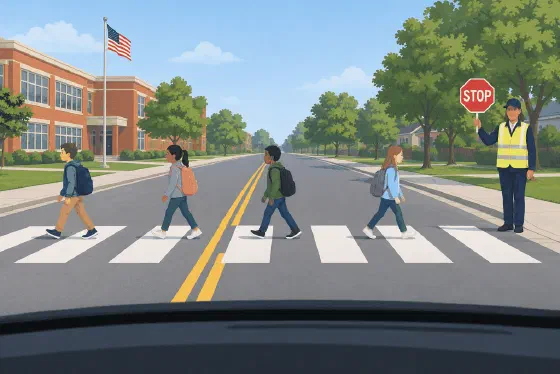
The picture shows a school crossing. Once the reduced school-zone limit is in effect, what is the maximum legal speed?
Why it's A: 15 mph
A school zone carries a 15 mph limit while the restriction is in effect, such as during school hours when children are around. Slow down and watch closely for students and crossing guards. Stop and wait whenever a crossing guard holds up a STOP sign or children are in the crosswalk.